
Woody Guthrie: The Man Who Sang for the People Nobody Wanted
From the Dust Bowl to the Woody Guthrie Center in Tulsa, the story of an American folk musician who believed that every person deserved to be seen, heard, and remembered.
Woody Guthrie was more than a musician. He was a storyteller, an observer of the human condition, and a voice for Americans whose struggles were too often ignored.
During our recent visit to the Woody Guthrie Center in Tulsa, Oklahoma, we discovered that his music was inseparable from his beliefs about people.
There are places we visit because they are on our itinerary. And then there are places that stay with us long after we've walked out the door.
The Woody Guthrie Center is one of those places.
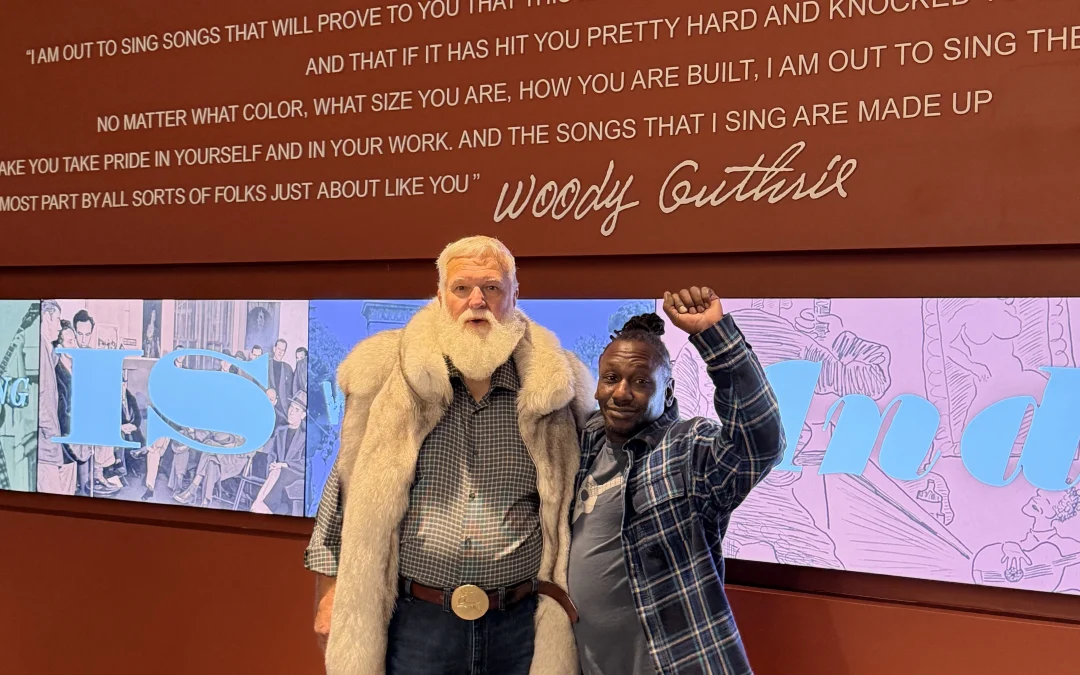
We had the opportunity to explore the museum with Sam Flowers, one of its guides. Sam was a wonderful host, sharing his knowledge and enthusiasm for Guthrie's life and legacy as we made our way through the exhibits.
Surrounded by handwritten lyrics, personal correspondence, and artifacts from a remarkable life, I found myself thinking less about the musician and more about the man.
Not because his music was unimportant. Quite the opposite.
Because the music was inseparable from what he believed about people.
And the more I learned, the more I realized that Woody Guthrie wasn't simply writing songs about America.
He was asking America to take a good look at itself.
Woody Guthrie: A Man Shaped by Hard Times
Woodrow Wilson Guthrie was born in Okemah, Oklahoma, on July 14, 1912, when the American frontier was giving way to a rapidly changing nation.
His early life was anything but easy.
Family tragedies, financial instability, and the illness of his mother shaped his childhood. As a young man, he experienced firsthand the uncertainty that would later become a recurring theme in his music.
By the 1930s, the Great Depression had devastated much of the country. For families living across the southern Great Plains, economic collapse was compounded by one of the worst environmental disasters in American history.
The Dust Bowl.
Years of drought, aggressive cultivation, and powerful winds stripped enormous stretches of farmland of their topsoil. Dust storms swallowed communities, destroyed crops, and made everyday life increasingly difficult.
Farmers who had worked the land for generations suddenly found themselves unable to support their families.
Banks foreclosed. Businesses closed. Communities began to empty.
And thousands of Americans loaded their belongings into automobiles and headed west.
California represented hope.
Woody Guthrie became one of those westward travelers, spending time among the displaced families whose experiences would shape his music.
They became known collectively as the Okies, although many came from Arkansas, Texas, Missouri, and other states.
The label was frequently used as an insult.
It suggested poverty, ignorance, and undesirability.
But Guthrie saw something different.
He saw families.
People who had worked, raised children, built homes, and contributed to their communities until circumstances beyond their control swept away much of what they had known.
Their circumstances had changed.
Their humanity had not.
The Dust Bowl Journey That Changed Woody Guthrie
When Woody Guthrie traveled west during the Depression, he encountered a world far removed from the promise of opportunity that had drawn so many families toward California.
Migrant workers struggled to find employment. Families lived in temporary camps, roadside shelters, and overcrowded accommodations.
Agricultural work was often seasonal, poorly paid, and physically demanding.
Many migrants discovered that California, despite its need for agricultural labor, was not particularly eager to welcome them.
Some communities viewed the newcomers as an economic burden. Others regarded them with outright hostility.
In 1936, Los Angeles police even established checkpoints near California's borders in an effort to discourage impoverished migrants from entering the state.
The operation became known as the Bum Blockade.
Imagine traveling hundreds of miles in search of work, only to discover that fellow Americans considered your poverty a reason to turn you away.
Guthrie witnessed the hardship, frustration, and resilience of people caught in these circumstances.
His songs became a form of storytelling that preserved their experiences.
Rather than describing the migrants as statistics or social problems, he wrote about their lives.
Songs such as Do Re Mi captured the bitter irony of California's promise: opportunity might be waiting, but reaching it without money did not guarantee a welcome.
Other songs addressed displacement, labor struggles, inequality, and the dignity of ordinary working people.
Woody Guthrie wasn't simply documenting the Great Depression.
He was giving its forgotten people a voice.
This Land Is Your Land: More Than a Patriotic Song
Perhaps no song better illustrates the complexity of Woody Guthrie than This Land Is Your Land.
Today, it is often performed at school assemblies, patriotic celebrations, and community gatherings.
Its familiar melody and descriptions of America's landscapes make it sound like an uncomplicated celebration of the country.
And in many ways, it is.
But the story behind the song reveals something deeper.
Guthrie wrote its earliest version in 1940, partly in reaction to the popularity of Irving Berlin's God Bless America.
He had grown weary of hearing an idealized vision of the country while so many Americans were struggling to survive.
The song's original manuscript included verses that are frequently omitted from modern performances.
One questioned the meaning of private-property boundaries.
Another described people standing in a relief line, waiting for food.
These verses weren't simply expressions of anger.
They raised a question that remains relevant today.
What does it mean to say that a country belongs to everyone when some of its people struggle to find a place within it?
Woody Guthrie understood the beauty of America.
He had traveled its highways, crossed its plains, and witnessed its remarkable landscapes.
But he also understood that a country's greatness cannot be measured by scenery alone.
It must also be measured by how its people treat one another.
That is what makes This Land Is Your Land more than a patriotic anthem.
It is both a celebration and a challenge.
A reminder that loving a country doesn't require pretending it is perfect.
Sometimes, loving something means being willing to ask difficult questions about it.
The Words on the Wall
One of the most meaningful displays at the Woody Guthrie Center features a statement about the purpose of his music.
Guthrie wanted to write songs that reminded people the world belonged to them, regardless of their color, size, or circumstances.
He wanted ordinary people to recognize their own worth.
Standing beneath those words, I was struck by how uncomplicated the sentiment really is.
Human dignity isn't something we earn through wealth, social position, or the approval of others.
It is something we possess.
Woody Guthrie understood that the man working in the fields, the family living out of an automobile, and the person struggling to find a place to sleep were not somehow less deserving of respect than those who had prospered.
Their circumstances were different.
Their humanity was not.
It is a distinction that seems obvious when we read about history.
Yet it is one we continue to struggle with in our own time.
Woody Guthrie and a Landlord Named Trump
One of the more unexpected discoveries during our visit involved Woody Guthrie's connection to a name that remains prominent in American life.
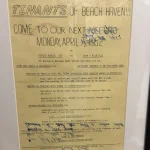
In the early 1950s, Guthrie lived at Beach Haven, an apartment development in Brooklyn owned by Fred Trump, father of Donald Trump.
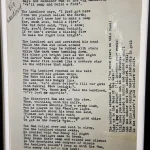
Among the materials displayed at the center were documents and handwritten writings reflecting Guthrie's concerns about racial discrimination and housing conditions.
Guthrie believed discriminatory practices were preventing Black families from enjoying the same housing opportunities as white tenants.
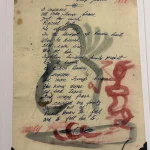
He expressed those concerns in his writing, including a pointed composition about Fred Trump and racial hatred.
More than two decades later, in 1973, the United States Department of Justice filed a housing discrimination lawsuit against Fred Trump, Donald Trump, and their company.
The lawsuit was settled in 1975 through a consent decree without an admission of wrongdoing.
Guthrie's writings and the later federal lawsuit were separate events, but both illuminate longstanding conflicts surrounding housing, discrimination, and economic power.
What interested me most wasn't the contemporary political connection.
It was the consistency of Guthrie's concern.
Whether he was writing about migrant workers in California or housing discrimination in Brooklyn, Woody Guthrie repeatedly returned to the question of who was being excluded and why.
He was willing to challenge what he believed was unjust, even when it involved the owner of the building where he lived.
The Man Behind the Music
It would be easy to turn Woody Guthrie into a flawless American hero.
But that would do him a disservice.
He was complicated, sometimes contradictory, and deeply political.
His personal relationships could be difficult, his convictions were not universally shared, and his life included considerable personal turmoil.
Guthrie was also associated with left-wing political movements and labor causes, reflecting the social conflicts of his era.
Later in life, he suffered from Huntington's disease, a hereditary neurological disorder that gradually robbed him of his physical and cognitive abilities.
He died in 1967 at the age of 55.
But reducing Woody Guthrie to his politics, his personal shortcomings, or his illness misses something essential.
He possessed an unusual ability to recognize the humanity of people society often overlooked.
He believed their stories mattered.
He believed their struggles deserved to be heard.
And he believed music could make people listen when ordinary conversation failed.
The Lasting Influence of Woody Guthrie
Woody Guthrie's influence didn't end with his death.
In many ways, it was only beginning.
His approach to songwriting helped establish a tradition in American music that treated songs as more than entertainment.
They could be historical records.
They could challenge injustice.
They could tell the stories of people whose experiences rarely appeared in newspapers or history books.
One of the most famous musicians influenced by Woody Guthrie was Bob Dylan.
As a young man, Dylan became fascinated with Guthrie's music and traveled to New York, where he visited the ailing musician.
Dylan's early songwriting reflected Guthrie's influence, particularly his use of folk music to address social issues and tell stories about ordinary people.
Over time, Dylan developed a distinctive artistic voice, but Guthrie's influence remained an important part of his musical foundation.
Bruce Springsteen also drew inspiration from Guthrie.
Springsteen's storytelling about working-class Americans, economic hardship, and the pursuit of dignity reflects a similar concern for people whose lives are shaped by forces beyond their control.
His 1995 album The Ghost of Tom Joad, named for the central character in John Steinbeck's The Grapes of Wrath, explores many of the same themes that Guthrie encountered during the Dust Bowl era.
The connections extend far beyond Dylan and Springsteen.
Artists such as Pete Seeger, Joan Baez, and Billy Bragg have carried forward aspects of Guthrie's musical and social legacy.
His songs continue to be performed, reinterpreted, and rediscovered by new generations.
What makes that legacy remarkable isn't simply the number of musicians he influenced.
It's the idea he helped preserve.
A song can entertain us. But it can also make us pay attention.
And sometimes, paying attention is the first step toward understanding someone else's life.
What Woody Guthrie Still Teaches Us
As we left the Woody Guthrie Center, I kept returning to the idea that the greatest value of travel isn't always found in discovering something new.
Sometimes it comes from being reminded of something we already know but have allowed ourselves to forget.
The people we encounter along the way have stories.
The person cleaning our hotel room, the worker harvesting our food, the stranger standing beside us in a crowded station, and the family searching for a better life all carry experiences we may never fully understand.
Woody Guthrie made a career of listening to those stories.
Then he gave them a melody.
His life reminds us that history is not merely a collection of dates, events, and famous names.
It is the accumulated experience of people who lived through circumstances we may never fully appreciate.
And those experiences have a way of reaching across generations.
The struggles of Dust Bowl migrants may seem distant from our modern world.
Yet the questions surrounding poverty, opportunity, migration, and belonging remain remarkably familiar.
Perhaps that is why Guthrie's music continues to resonate.
Not because every answer he offered was correct, or because every opinion he held deserves our agreement.
But because he kept asking us to see the people standing right in front of us.
And maybe, more than anything else, that's what a resonant journey should do.
It should change not only what we see, but how we see one another.
The Resonant Explorer is where we follow the stories, people, places, and unexpected discoveries that make travel so much more than simply visiting another destination. Some stories are planned. Others find us. And those are often the ones that stay with us the longest.
Robert Riesmeyer is the Founder and Travel Concierge/Host of Epic Explorations and the voice behind The Resonant Explorer. A lifelong traveler, storyteller, and relentlessly curious explorer, Robert looks beyond the obvious—into the people, history, culture, and unexpected stories that give a place meaning.
Based in the Kansas City area, he explores the world, follows intriguing rabbit holes, and seeks experiences most travelers overlook. For Robert, travel isn't about collecting destinations. It's about curiosity, connection, wonder, and discovering the stories that stay with us long after we return home.