
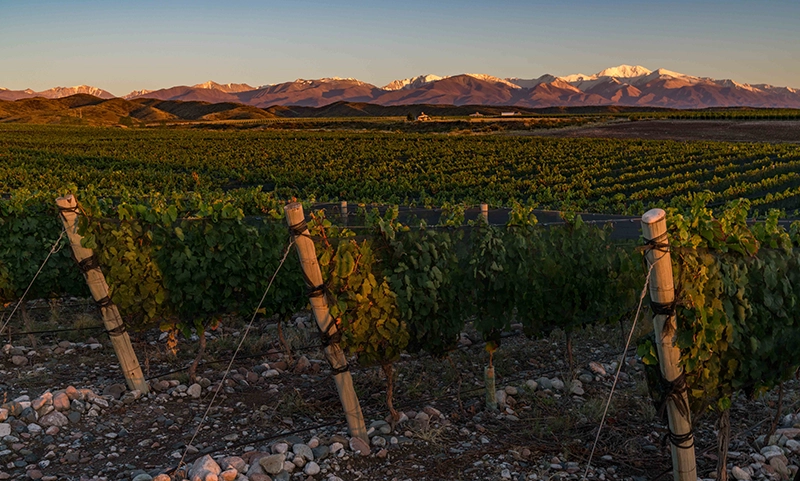
Photo Credit: Susana Balbo Wines
Beyond the Familiar: What Can a Grape Tell Us About a Place?
Next Saturday, Linda and I are going looking for grapes we've never tasted.
More specifically, we're going in search of local wine grapes—grapes that can tell us something about the place where they're grown.
Our destination is TerraVox Winery, just north of Kansas City, where we'll encounter names like Wetumka, Cloeta, Albania, America, Herbemont, Hidalgo, and perhaps several others that would leave most of us staring blankly at a wine list.
And I can't wait.
Our upcoming visit grew out of my recent rabbit hole into American native wine grapes and a question I haven't been able to shake:
What does America taste like when we allow it to taste like itself?
But somewhere along the way, another question occurred to me.
Why stop with America?
Because some of my favorite discoveries while traveling have come when someone poured something into my glass that I wasn't expecting.
And immediately my mind went back to Argentina.
The Wine We Found in Argentina
Linda and I were staying at Susana Balbo's Winemaker's House & Spa Suites in Mendoza when I became acquainted with Torrontés.
I knew Argentina for Malbec.
Of course I did.
That's the grape most of us associate with Argentina.
But then there was Torrontés.
Aromatic. Floral. Fresh. Different.
It didn't taste like Chardonnay.
It wasn't trying to be Sauvignon Blanc.
It wasn't something familiar wearing an Argentine costume.
It tasted like something that belonged there.
And that is precisely what made it memorable.
Later I learned there was an even better story hiding in that glass.
Torrontés Is an Argentine Story
Technically, calling Torrontés an “indigenous grape” requires a little explanation.
The principal variety used for fine wine, Torrontés Riojano, didn't exist in Argentina before Europeans arrived. Genetic research has traced it to a natural crossing between Muscat of Alexandria and Criolla Chica.
But that crossing happened in Argentina.
Torrontés Riojano was essentially born there.
Today it has become Argentina's emblematic white wine grape.
That makes it fascinating to me.
Because sometimes a place doesn't simply preserve something ancient.
Sometimes a place creates something new that eventually becomes part of its identity.
That's one of the things I find so interesting about local wine grapes. Their stories aren't always thousands of years old. Sometimes the relationship between a grape and a place develops over generations until the two become almost inseparable.
And then there's Susana Balbo.
The Queen of Torrontés
I didn't fully appreciate the connection when Linda and I were there, but Susana Balbo's relationship with Torrontés is part of modern Argentine wine history.
Early in her career, Susana worked in Cafayate in Argentina's Salta region. At the time, Torrontés was often treated as an ordinary blending or table-wine grape rather than something capable of producing truly serious wine.
She saw something different.
Through changes in vineyard and winemaking practices, Susana helped demonstrate that Torrontés could produce elegant, aromatic, high-quality wines.
She became known as the Queen of Torrontés.
Think about the parallel.
In Missouri, Jerry Eisterhold looks at grapes most people have forgotten and asks:
What could these become?
Decades earlier in Argentina, Susana Balbo looked at a grape people weren't taking particularly seriously and asked essentially the same question.
What could this become?
That's where this rabbit hole gets interesting.
Maybe We Should Travel by Grape
We often travel by destination.
We're going to Argentina.
We're going to Portugal.
We're going to Greece.
We're going to Georgia.
We're going to Italy.
But what if occasionally we traveled by grape?
Not Cabernet Sauvignon.
Not Chardonnay.
Not Merlot.
Not the international varieties that follow us almost everywhere.
What if we searched for the local wine grapes that tell us something about where we actually are?
Suddenly the wine list becomes a map.
And there are hundreds—actually thousands—of trails we could follow.
Local Wine Grapes Can Become Storytellers
That's where this idea becomes more interesting than simply finding unusual wines.
A local grape can tell us about climate.
Soil.
History.
Agriculture.
Migration.
Trade.
Tradition.
Even survival.
Some varieties flourish because generations of growers discovered that they were uniquely suited to a particular landscape. Others survived because a handful of people refused to abandon them.
And some became so intertwined with a destination that tasting the grape while standing in that place becomes an experience unto itself.
Consider Greece.
Greece Gives Us Assyrtiko
Go to Santorini and you'll encounter Assyrtiko.
The grape has become closely associated with the volcanic island, where vines traditionally grow low to the ground in basket-like formations that help protect the grapes from fierce winds.
Now imagine drinking that wine while standing on Santorini.
You're no longer simply tasting a white wine.
You're tasting a response to wind, volcanic soil, intense sunlight, scarcity of water, and generations of human adaptation.
The grape becomes a storyteller.
That's what makes local wine grapes so compelling to me.
The wine doesn't simply come from somewhere.
It helps explain somewhere.
Georgia Gives Us Saperavi
Then travel east to Georgia—one of the world's ancient centers of winemaking—and you'll encounter Saperavi.
Even visually, it's unusual.
Most red wine grapes have dark skins but relatively clear juice. Saperavi belongs to a much smaller group of grapes known as teinturier varieties, whose flesh and juice also contain pigment.
The result can be deeply colored, structured wines.
But the grape is only part of the Georgian story.
Pair it with Georgia's ancient qvevri winemaking tradition—fermenting and aging wine in large clay vessels buried underground—and suddenly we're no longer discussing whether a bottle received 94 points.
We're talking about civilization.
Portugal May Be the Ultimate Rabbit Hole
Portugal could keep us occupied for years.
Touriga Nacional.
Touriga Franca.
Baga.
Arinto.
Encruzado.
Alvarinho.
Trincadeira.
Castelão.
And that's barely opening the door.
One of the things I love about Portugal is that it hasn't completely surrendered its wine identity to the handful of international varieties recognized everywhere else.
Order wine there and you're likely to encounter local wine grapes you've never heard of.
Good.
That's part of traveling.
I don't necessarily want everything translated into something I already understand.
Sometimes I want to be handed a glass and told:
“This grows here.”
Now you have my attention.
Italy Could Make This a Lifetime Project
Then there's Italy.
Nebbiolo.
Sangiovese.
Aglianico.
Nerello Mascalese.
Fiano.
Verdicchio.
Carricante.
Garganega.
Hundreds of other varieties remain tied to particular regions, valleys, villages, and traditions.
You could probably spend the rest of your life traveling through Italy asking one simple question:
What grows here that doesn't really belong anywhere else?
And you'd never run out of answers.
Which brings me back to the idea of terroir.
Maybe Terroir Begins With Curiosity
We tend to make wine intimidating.
We talk about vintages.
Scores.
Appellations.
Soil classifications.
Fermentation techniques.
Barrel regimes.
And there is absolutely a place for understanding those things.
But perhaps there's an easier way into wine.
Be curious.
Ask what grows here.
Ask why.
Ask who still grows it.
Ask what almost disappeared.
Ask who preserved it.
Ask what the grandparents drank.
Ask what grape the winemaker wishes visitors understood better.
Ask what bottle they would pour if they wanted you to understand their home.
Those questions lead somewhere entirely different.
They lead to people.
And perhaps that's the best way to approach local wine grapes when we travel. We don't need to become sommeliers before we can appreciate them.
We simply need to ask questions.
The Grapes We Almost Lost
This may be the part of the rabbit hole that interests me most.
Some grape varieties became global celebrities.
Others nearly disappeared.
Sometimes economics was responsible.
Sometimes disease.
Sometimes changing tastes.
Sometimes vineyards were replanted with varieties that were easier to sell.
Sometimes growers simply stopped believing the old grapes were worth keeping.
And then, occasionally, somebody refused to let one disappear.
That's the person I want to meet.
Because now we're moving beyond wine.
We're talking about memory.
Agriculture.
Family.
Tradition.
Science.
Persistence.
And perhaps a little obsession.
Those are exactly the stories we're searching for at Epic Explorations.
And they remind us that preserving local wine grapes can also mean preserving a piece of a place's identity.
Which Brings Us Back to Missouri
Next Saturday, Linda and I won't need passports.
We won't fly to Argentina, Greece, Georgia, Portugal, or Italy.
We'll drive north of Kansas City.
And we'll taste grapes with names like Wetumka, Cloeta, Albania, America, and Norton.
TerraVox grows its own grapes on 14 acres and has dedicated itself to exploring the possibilities of North America's native grape varieties. Its vineyard includes an extraordinary collection connected to the work of American viticulturist T.V. Munson.
Wetumka alone has already captured my curiosity.
Developed by Munson in 1893, it can produce a wine with aromas TerraVox describes as green pineapple and lemon verbena, finishing crisp and carrying enough natural acidity that a touch of residual sugar can help bring the wine into balance.
I have read about it.
Next weekend, hopefully, I'll taste it.
And there's an important difference between those two things.
From Torrontés to Wetumka
That's what has me thinking about that glass of Torrontés in Argentina.
I didn't discover Torrontés because I searched the internet for obscure wine grapes.
I discovered it because I went somewhere.
Someone poured it.
I tasted it.
I became curious.
And years later, that memory came rushing back because another grape in another place asked essentially the same question.
Are you curious enough to taste where you are?
That's a question worth carrying with us.
When we're in Argentina, drink Torrontés.
When we're in Portugal, ask about the grape you've never heard of.
When we're in Greece, find Assyrtiko.
When we're in Georgia, taste Saperavi.
When we're in Italy, ask what's grown locally rather than ordering something familiar.
Seek out the local wine grapes that generations of growers and winemakers have connected to that particular place.
And next Saturday, when Linda and I are standing north of Kansas City...
Pour me the Wetumka.
Pour me the Cloeta.
Pour me the America.
Pour me whatever Jerry thinks we need to taste.
Because perhaps one of the greatest pleasures of wine isn't discovering another great bottle.
It's discovering another place.
And sometimes all it takes to begin that journey is a grape you've never heard of.

Explore Your World Epically
Robert Riesmeyer is the Founder and Travel Concierge/Host of Epic Explorations and the voice behind The Resonant Explorer. A lifelong traveler, storyteller, and relentlessly curious explorer, Robert looks beyond the obvious—into the people, history, culture, and unexpected stories that give a place meaning.
Based in the Kansas City area, he explores the world, follows intriguing rabbit holes, and seeks experiences most travelers overlook. For Robert, travel isn't about collecting destinations. It's about curiosity, connection, wonder, and discovering the stories that stay with us long after we return home.