
Michael the Archangel: One Badass Angel and an Unexpected Discovery in Korčula
How a leisurely lunch in a medieval Croatian town led us down a rabbit hole involving a centuries-old chapel, a mysterious skull, and the warrior who leads heaven's armies.
Sometimes the Best Discoveries Happen When You Stop Looking
We came to Korčula to explore.
Not to chase angels, investigate ancient religious symbolism, or contemplate the great spiritual battles described in the Bible.
We came to experience an island.
Korčula sits in the Adriatic Sea along Croatia's Dalmatian coast, a place where history seems to rise from the limestone beneath your feet. The island has its vineyards, olive groves, quiet villages, and beautiful stretches of coastline, but its medieval Old Town is something special.
Perched on a small peninsula, the town is a wonderful collection of narrow stone streets, weathered buildings, hidden courtyards, and centuries of history layered one upon another.
The Venetians left their fingerprints here. So did generations of sailors, merchants, craftsmen, priests, and ordinary families who called this island home.
And everywhere you look, there seems to be another story waiting to be discovered.
Linda and I were doing what we enjoy most when exploring somewhere new.
Wandering.
We weren't racing from one attraction to another. We weren't trying to squeeze every monument into a carefully managed schedule. We were simply enjoying Korčula, following our curiosity through the old streets, taking photographs, and appreciating the remarkable surroundings.
Eventually, we got hungry.
So we found a café, sat down for lunch, and settled in to enjoy a little Croatian hospitality.
Nothing particularly extraordinary about that.
Except for what was sitting directly in front of us.
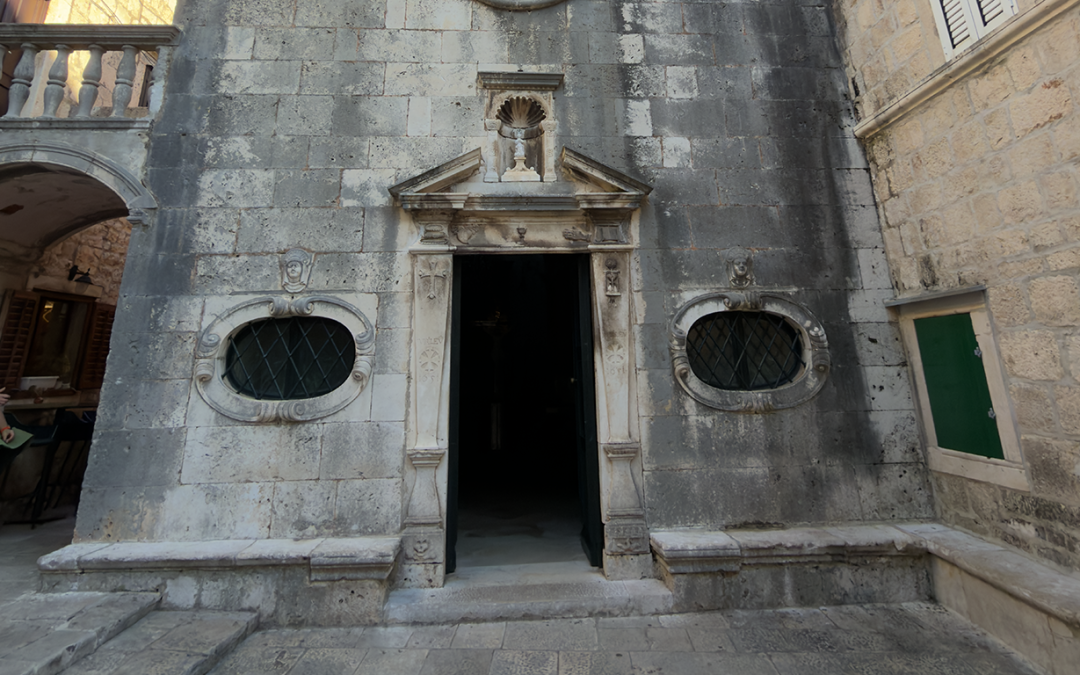
A chapel.
A small, centuries-old stone chapel, tucked into the historic streetscape as though it had been waiting patiently for someone to notice it.
It wasn't particularly imposing. Certainly nothing like the great cathedrals of Europe.
But it had character.
Its façade was built of weathered limestone, with two unusual oval windows flanking a richly decorated doorway. Above them was a circular stone window, and higher still, a bell gable holding two bells.
The building had clearly been there for a very long time.
And then something caught my eye.
A skull.
Not a painted skull. Not a modern decoration.
A skull carved into the stone at the base of the doorway.
Now that was interesting.
And just like that, lunch became the beginning of another rabbit hole.
A Skull, a Stone Doorway, and a Few Questions
I have always been fascinated by the little details people overlook.
The grand monuments get all the attention, but sometimes it's a carving tucked into a corner, a name etched into a wall, or an unusual symbol above a doorway that tells the more interesting story.
This particular doorway had plenty to investigate.
There were religious symbols, decorative stonework, and inscriptions worn by centuries of weather.
And down near the ground was that skull.
On the opposite side of the entrance was another carving. At first glance, it looked like it might be some variation of crossed bones, although a closer examination suggests something more complicated: a stylized motif that could be vegetal, heraldic, or otherwise symbolic.
I couldn't confidently identify it.
But the skull was unmistakable.
What was it doing there?
Was it a warning?
A reminder of death?
Was there some connection to a religious brotherhood?
And whose chapel was this, anyway?
The answer to that last question was surprisingly easy.
We were sitting in front of the Church of St. Michael, known locally as Crkva sv. Mihovila and by its Italian name, San Michele.
St. Michael.
As in Michael the Archangel.
Now we were getting somewhere.
Because Michael isn't just another figure in Christian history.
He's the warrior of heaven.
The defender of God's people.
The angel who confronts Satan.
And, as I would soon be reminded, one of the most formidable characters anywhere in Scripture.
In other words, Michael is one serious badass.
The Little Chapel Dedicated to Heaven's Warrior
St. Michael's Church has stood in Korčula for centuries.
Its history reaches back to the early fifteenth century, although much of its present architectural appearance reflects later renovations and additions.
In 1603, a religious confraternity dedicated to St. Michael and Our Lady of Consolation was established in Korčula and became associated with the church.
These confraternities were an important part of religious and community life throughout medieval and early modern Dalmatia.
They were organizations of laypeople, ordinary men and women who gathered around shared religious commitments, charitable activities, prayer, and mutual assistance.
Some helped care for the poor. Others assisted the sick, supported religious observances, or helped ensure that members received appropriate Christian burials.
They were expressions of faith lived within a community.
And in a maritime town such as Korčula, where life could be unpredictable and the sea was both a livelihood and a danger, questions of protection, mortality, and eternal life were never far away.
That doesn't prove why someone carved a skull into the chapel's doorway.
But it gives us a world in which such a symbol makes sense.
In Christian art, the skull frequently represents memento mori, a Latin expression meaning "remember that you must die."
It isn't necessarily meant to frighten people.
Rather, it reminds them that life is temporary and that what we do with our time matters.
Michael, meanwhile, developed a particularly strong association in Christian tradition with the protection of souls and their passage toward judgment.
Was that the connection intended by the stonecarver?
Perhaps.
But until we can establish the history of those particular carvings, it remains a possibility rather than a documented fact.
And that's where the more interesting question emerged.
Who exactly was Michael?
Not the Michael of paintings, statues, and religious legends.
The Michael of Scripture.
Michael the Archangel: Not Your Average Angel
Let's get one thing straight.
The Michael described in the Bible is not some delicate, harp-playing celestial being floating around on a cloud.
He is a warrior.
A protector.
A leader.
And when Scripture pulls back the curtain on the spiritual realm, Michael appears in some extraordinary circumstances.
Interestingly, he is mentioned by name only a handful of times in the Protestant biblical canon.
Three times in Daniel, once in Jude, and once in Revelation.
That's it.
Five references.
Yet those five references have inspired centuries of theology, art, pilgrimage, and religious devotion.
They've also inspired some spectacular churches and sanctuaries across Europe.
But before we go chasing those stories, we need to meet Michael as Scripture actually presents him.
And the best place to begin might be the last book of the Bible.
Because when heaven goes to war, Michael leads the charge.
When Heaven Went to War
Revelation 12:7–9 describes one of the most dramatic scenes in Scripture.
"Now war arose in heaven, Michael and his angels fighting against the dragon."
Read that again.
War arose in heaven.
Michael and his angels were fighting against the dragon.
The passage identifies the dragon as the ancient serpent, the devil, Satan.
And Satan isn't alone.
He has angels fighting alongside him.
This is no minor disagreement.
John describes a cosmic conflict between opposing spiritual forces, with Michael leading the heavenly angels.
The dragon fights back.
But he loses.
Satan and his angels are cast down.
It's an extraordinary image, and one that artists have been depicting for centuries.
Michael wearing armor.
Sword raised.
Wings spread.
A defeated dragon beneath his feet.
Some portrayals are magnificent. Others are almost terrifying.
But here's something important.
Revelation doesn't tell us what Michael's armor looked like. It doesn't describe the sword he carried, or even explicitly say he carried one.
Those details belong largely to the artistic traditions that developed later.
What Scripture tells us is that Michael fought, his angels fought with him, and the dragon was defeated.
The surrounding passage makes clear that the ultimate victory belongs to God and His Messiah.
Michael is not some independent supernatural champion.
He's a servant carrying out the purposes of God.
And that distinction becomes even more interesting when we encounter him in another biblical passage.
Because Michael isn't simply powerful.
He's disciplined.
The Angel Who Confronted Satan but Knew His Limits
Jude 1:9 contains one of the strangest little accounts in the New Testament.
Michael the Archangel is disputing with the devil over the body of Moses.
Yes, the body of Moses.
Why?
That's an excellent question.
And the Bible doesn't tell us.
The account appears to draw upon Jewish traditions surrounding Moses' death, some of which circulated outside the books included in the biblical canon.
But Jude's purpose isn't to explain the dispute.
It's to illustrate something about authority and restraint.
Even while confronting the devil, Michael refuses to pronounce a condemning judgment on his own authority.
Instead, he says:
"The Lord rebuke you."
Think about that for a moment.
Here is the same Michael who commands angels in battle against Satan.
The same Michael associated with the protection of God's people.
And yet he doesn't presume to exercise an authority that belongs to God.
He doesn't boast.
He doesn't threaten to settle the matter through his own power.
He appeals to the Lord.
That's not weakness.
That's discipline.
It's the difference between possessing power and understanding how that power should be used.
I've known some remarkable people over the years, including individuals whose professional lives required extraordinary courage, strength, and the ability to operate under enormous pressure.
One characteristic I've noticed among the best of them is that genuine confidence rarely needs to announce itself.
The most capable people don't necessarily have to be the loudest people in the room.
They understand their responsibilities.
They recognize the limits of their authority.
And they know when restraint is more important than force.
I find something of that same principle in Michael.
He doesn't confuse his assignment with his identity.
His authority comes from God.
And he never seems to forget it.
Twenty-One Days: The Battle We Know Almost Nothing About
Now let's go back several centuries before Revelation, to the Book of Daniel.
Because this is where Michael's story becomes genuinely mysterious.
In Daniel 10, the prophet receives a vision and spends three weeks mourning and fasting.
Eventually, a heavenly messenger appears and explains that his arrival was delayed.
For twenty-one days.
Why?
Because he was opposed by someone described as the prince of the kingdom of Persia.
The messenger explains that Michael, "one of the chief princes," came to help him.
That's an extraordinary statement.
We are suddenly given a glimpse into a spiritual conflict that seems to exist beyond ordinary human perception.
A heavenly messenger.
A prince of Persia.
Twenty-one days of resistance.
And Michael intervening.
What exactly was happening?
Who was this prince of Persia?
Was this an earthly ruler, a spiritual being associated with the Persian Empire, or something else?
Many Christian interpreters understand the passage as describing spiritual powers operating behind earthly political kingdoms.
But the text doesn't answer every question.
And I think that's worth remembering.
Sometimes we become so determined to explain every biblical mystery that we forget how much Scripture leaves unexplained.
We know Michael helped.
We know the messenger eventually reached Daniel.
And we know the passage presents a conflict involving powers far beyond the ordinary politics of ancient Persia.
Beyond that, we should be careful not to claim more certainty than the text provides.
Still, imagine the scene.
Twenty-one days of resistance.
And then Michael arrives.
You begin to understand why I find this angel so fascinating.
The Great Prince Who Protects God's People
Michael appears again in Daniel 12:1.
This time, he is described as the great prince who stands over Daniel's people.
The passage concerns a time of extraordinary trouble and the deliverance of those whose names are found written in the book.
Here, Michael is not simply a warrior confronting an enemy.
He is a protector.
A guardian.
Someone entrusted with responsibility for God's people.
That adds another dimension to his character.
Strength alone is not particularly impressive.
History is filled with powerful individuals who used their strength to exploit, intimidate, or destroy.
But strength employed in defense of others?
That's something different.
It's the difference between a bully and a protector.
Between someone who seeks power for himself and someone who accepts responsibility for those entrusted to his care.
And in the biblical picture of Michael, that responsibility is central.
He fights.
But he fights in service to God and in defense of God's purposes.
His Name Says Everything
Here's one of my favorite details about Michael.
His name comes from the Hebrew Mikha'el.
It means:
"Who is like God?"
Not "I am like God."
Not "I possess the power of God."
It's a question.
And the implied answer is simple.
No one.
There's something wonderfully appropriate about that.
Because everything we see Michael doing in Scripture seems consistent with the meaning of his name.
He is powerful, but not divine.
He possesses authority, but not ultimate authority.
He confronts evil, but doesn't claim the right to pronounce God's judgment independently.
He serves.
And in that service, he demonstrates a kind of strength that seems increasingly uncommon.
Courage without arrogance.
Power without vanity.
Authority without self-importance.
It's quite a combination.
And perhaps that's one reason Michael has captured the Christian imagination for so many centuries.
From the Bible to the Mountains of Europe
If Michael appeared only a handful of times in Scripture, how did he become one of the most recognizable figures in Christian art and architecture?
That's another rabbit hole.
And it takes us across Europe.
In southern Italy, on the Gargano Peninsula, stands the Sanctuary of Monte Sant'Angelo.
According to longstanding Christian tradition, Michael appeared there during late antiquity, and the site became one of Europe's important pilgrimage destinations.
The stories of those appearances are traditions rather than independently established historical events, but their influence on Christian devotion is undeniable.
Then there's Mont-Saint-Michel in Normandy, France.
Few religious buildings anywhere in the world occupy a more extraordinary setting.
Rising from a rocky tidal island, the medieval abbey seems almost impossibly placed between sea and sky.
Tradition holds that Michael appeared to Bishop Aubert in the early eighth century, inspiring the establishment of a sanctuary.
Over the centuries, it grew into one of Europe's great pilgrimage destinations.
And in northern Italy, the Sacra di San Michele stands high above the Susa Valley, a remarkable medieval abbey perched on a rocky mountain.
There are other sanctuaries dedicated to Michael, too.
Some people even speak of a Sacred Line of Saint Michael, a supposed alignment of seven important Michael sanctuaries stretching from Ireland toward the eastern Mediterranean.
It's a fascinating modern popular tradition, although claims that the sites were deliberately established along a single ancient sacred line are not supported by convincing historical evidence.
Still, the geography is intriguing.
Across mountains, islands, coastlines, and centuries, Christians built places of worship dedicated to the same archangel.
Some are enormous.
Some are architectural masterpieces.
And some are modest chapels tucked into the streets of small Adriatic towns.
Like the one Linda and I happened to find while having lunch in Korčula.
But Why the Skull?
Now we have to return to the question that started all of this.
Why was there a skull carved into the doorway of St. Michael's Chapel?
In European Christian art, skulls have long been associated with mortality, repentance, and the temporary nature of earthly life.
The Latin phrase memento mori captures the idea beautifully.
Remember that you must die.
It may sound grim to modern ears.
But the original purpose wasn't necessarily morbid.
It was meant to encourage reflection.
Life is short.
Time is precious.
And the choices we make matter.
Christian art frequently uses skulls in depictions of saints, particularly those contemplating repentance, mortality, and the hope of eternal life.
In later Christian tradition, Michael also became associated with the weighing of souls.
You've probably seen the images.
Michael stands holding a set of scales, while the souls of the dead are symbolically weighed.
Sometimes demons attempt to interfere.
Sometimes the scene appears as part of a larger depiction of the Last Judgment.
These images are not literal descriptions taken from the biblical passages about Michael.
They belong to the broader development of Christian religious art and tradition.
But they help explain why Michael became closely associated with questions of death, judgment, and salvation.
And that brings us back to Korčula.
Could the skull at the chapel's doorway reflect those traditions?
Certainly.
Could it also relate to the devotional practices of the confraternity associated with the church?
Possibly.
But I haven't found a reliable historical explanation of that specific carving.
Nor can I confidently identify the unusual motif on the opposite side of the doorway.
It may be tempting to call the pair a skull and crossbones, but the second carving is not clearly a conventional pair of crossed bones.
And sometimes the responsible thing to do is admit that a mystery remains a mystery.
That doesn't make it any less interesting.
In fact, it gives me another reason to return to Korčula.
Perhaps next time I'll find someone who knows the history of the stonecarver, the doorway, and the symbols chosen to decorate it.
Maybe the answer is waiting in a local archive.
Maybe a historian familiar with Korčula's religious brotherhoods has already solved the puzzle.
Or maybe the stone has kept its secret for centuries.
Either way, it certainly accomplished one thing.
It made me curious.
The Warrior, the Servant, and the Question Worth Asking
The more I thought about Michael, the more I realized that his most remarkable characteristic might not be his ability to fight.
It's his understanding of whom he serves.
That may seem like an odd conclusion after reading about battles in heaven, confrontations with Satan, and mysterious spiritual conflicts lasting twenty-one days.
But consider the pattern.
In Revelation, Michael leads the angels against the dragon.
In Daniel, he intervenes on behalf of God's people.
In Jude, he refuses to overstep his authority.
And even his name points away from himself.
Who is like God?
No one.
That's quite a contrast to the way power is often understood in our world.
We tend to celebrate the person who dominates the room, commands the most attention, or insists on being recognized.
But Michael's example points toward something else.
Strength grounded in purpose.
Courage governed by discipline.
Authority exercised with humility.
A willingness to fight when necessary, but never to forget who ultimately holds the power.
As a Christian, I find that worth contemplating.
Not because Michael should become the center of our faith. That place belongs to Christ.
But because Michael's example reminds us that even extraordinary strength finds its proper purpose in faithful service.
And perhaps that is what makes him such a compelling figure.
Not merely that he is powerful.
But that he knows exactly what his power is for.
All Because We Stopped for Lunch
Eventually, of course, lunch came to an end.
The café continued serving its customers.
People wandered through the old streets.
The bells remained above the little chapel, and the weathered stone doorway stood much as it had for generations.
Most people probably passed without giving it much thought.
And I understand that.
Korčula is filled with beautiful buildings, fascinating history, and wonderful things to experience.
You can't investigate every doorway.
You can't follow every question.
You certainly can't chase every rabbit hole.
Although I've been known to try.
But every now and then, something catches your attention.
A detail.
An unusual carving.
A name.
A story you thought you knew, only to discover that you barely knew it at all.
And suddenly, a perfectly ordinary afternoon becomes something memorable.
Linda and I came to Korčula to explore a beautiful Croatian island.
We wandered through its medieval streets.
We stopped for lunch.
And there, sitting directly in front of us, was a little chapel dedicated to Michael the Archangel.
One of the most formidable figures in Scripture.
A warrior.
A protector.
A servant of God.
And, in my estimation, one serious badass.
All because I noticed a skull carved into a doorway.
That's the wonderful thing about curiosity.
You never know where it will take you.
And sometimes the most extraordinary journeys begin when you aren't going anywhere at all.
Travel starts the moment you leave your comfort zone.
Sometimes, all it takes is sitting down for lunch and looking across the street.
The Resonant Explorer is where we follow the stories, people, places, and unexpected discoveries that make travel so much more than simply visiting another destination. Some stories are planned. Others find us. And those are often the ones that stay with us the longest.
Robert Riesmeyer is the Founder and Travel Concierge/Host of Epic Explorations and the voice behind The Resonant Explorer. A lifelong traveler, storyteller, and relentlessly curious explorer, Robert looks beyond the obvious—into the people, history, culture, and unexpected stories that give a place meaning.
Based in the Kansas City area, he explores the world, follows intriguing rabbit holes, and seeks experiences most travelers overlook. For Robert, travel isn't about collecting destinations. It's about curiosity, connection, wonder, and discovering the stories that stay with us long after we return home.