
Echoes of Power, Ritual, and the Pre-Inca Mind
Chavín de Huántar — Where Stone, Spirit, and Sound Converge
In the shadow of Peru's snow-laced Cordillera Blanca, hidden far from the well-worn pilgrimages to Machu Picchu, lies something older, deeper, and eerily more mystical: Chavín de Huántar. This is no ordinary ruin. It's not just a place on the map—it's a portal to another way of thinking, living, and worshiping. And for travelers who crave more than just pretty pictures and passport stamps, it offers something truly unforgettable: the spiritual blueprint of one of the Americas' earliest and most influential cultures.
Before the Inca—There Was Chavín
Before Cusco rose to power and Incan stonework stunned the world, Chavín de Huántar was the epicenter of an advanced religious civilization. Flourishing between 900 and 200 BCE, the Chavín people orchestrated a cultural revolution not with war, but with ideas. Here, at a sacred junction between coast, highlands, and jungle, they erected a ceremonial complex so sophisticated in design, ideology, and sensory manipulation that it still leaves archaeologists awestruck.
Their tool of control? Not armies. Not gold. But belief is strategically reinforced through architecture, sound, shadow, hallucinogens, and sheer awe.
Why Chavín de Huántar Still Matters
There's something extraordinary about walking through a temple designed to alter your consciousness. The Chavín architects weren't just builders; they were psychological engineers. The temple's serpentine tunnels, flickering light shafts, and subterranean echoes weren't just aesthetic. They were designed to disorient, initiate, and transform. Visitors weren't just pilgrims. They were participants in a sensory symphony aimed at elevating the human spirit—and reinforcing the priesthood's divine authority.
At Chavín de Huántar, spirituality and statecraft merged in ways still not fully understood.
The Journey to the Oracle—Why Travel to Chavín de Huántar?
Peru has no shortage of breathtaking sites, but Chavín de Huántar offers something radically different: an unfiltered connection to a pre-Inca world that remains shrouded in mystery.
Getting there isn't simple. From Huaraz—a vibrant mountain town beloved by trekkers—it's a winding, high-altitude drive through dramatic Andean scenery. Think snow-draped peaks, sapphire lakes, and switchbacks that flirt with the clouds. But the journey is part of the reward. Each mile strips away the noise of modern life, preparing you for the spiritual weight of what awaits.
By the time you step onto the stone paths of Chavín de Huántar, you're not just visiting an ancient temple—you're stepping into the pulse of a forgotten belief system.
The Temple Complex — Design with Purpose
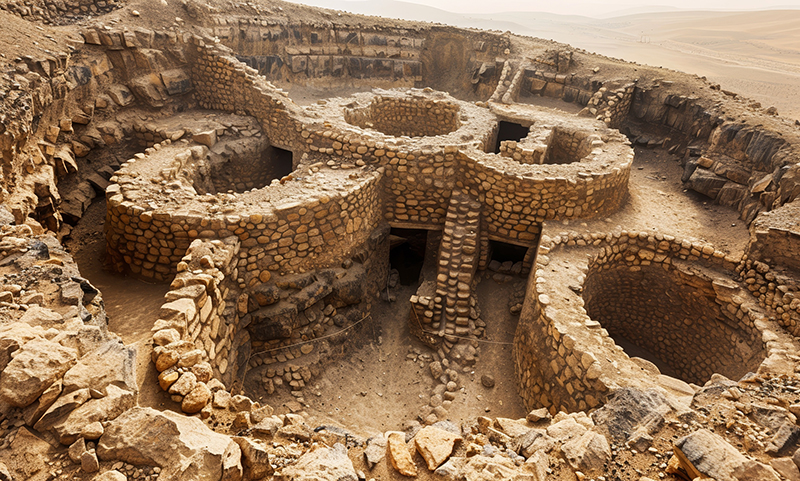
The heart of Chavín de Huántar is its dual temple structure: the Old Temple, built around 900 BCE, and the New Temple, added several centuries later. Each contains ceremonial plazas, underground galleries, and finely carved stone reliefs that suggest a society deeply attuned to cosmic order and human psychology.
The underground tunnels weren't simply storage or passageways. They were sensory chambers. With limited light, claustrophobic corridors, and roaring water from underground channels, visitors would be overwhelmed—ripe for transformation.
And it worked. People traveled for days, even weeks, to stand in awe here. They weren't just witnessing a ritual. They were becoming part of it.
The Lanzón – Heart of the Oracle
Deep inside the temple lies the Lanzón, a 15-foot-tall, dagger-like granite monolith etched with the features of a god: feline fangs, serpentine hair, and piercing eyes. It's believed this was the primary oracle of Chavín de Huántar—a literal and symbolic axis mundi connecting the human and divine.
This sacred sculpture wasn't just art. It was authority, power, and presence incarnate.
Its placement is genius. Pilgrims would enter the temple's dark corridors and—after being disoriented by sound, shadow, and hallucinogenic ritual—encounter the Lanzón face-to-face. Imagine the impact: vision blurred, heart racing, and suddenly you're staring at the embodiment of divinity in stone.
Cabezas Clavas – The "Nailed Heads" of Power
Lining the exterior walls of Chavín de Huántar were grotesque stone heads called Cabezas Clavas. Some human, some animal, some disturbingly in-between. Their fierce expressions and twisted features suggest transformation, possibly under the influence of powerful psychoactive rituals.
Were these symbols of protection? Warnings to outsiders? Or reminders of what happens when one crosses into the divine? Probably all three.
Hallucinogens and the Chavín Mindset
One of the most compelling theories about Chavín de Huántar is its ritual use of San Pedro cactus, a powerful hallucinogen containing mescaline. Evidence of carved snuff tubes, ceremonial cups, and depictions of visionary states all support the idea that altered consciousness was central to religious practice.
But this wasn't recreational use. This was ritualized, sacred, hierarchical. The priests—seen as intermediaries between worlds—would ingest San Pedro, enter trance states, and issue divine pronouncements to gathered pilgrims. Water sounds would echo. Light would flicker. Stone walls would seem to move. And the gods would speak.
These experiences weren't illusion. They were controlled awakenings—carefully choreographed by the high priests of Chavín to instill awe, obedience, and belief.
Engineering Mysticism — Water, Sound, and Stone
Let's not forget the engineering genius. Chavín de Huántar features a complex hydraulic system of underground canals that not only prevented flooding but created powerful acoustic effects. Water would rush through these channels during ceremonies, mimicking the roar of jaguars, the sacred animal of transformation.
This was early sound engineering, used to enhance mystical encounters. Water became a voice. Stone became a conductor. And the entire complex became a living, breathing instrument of the divine.
UNESCO Recognition and Modern Rediscovery
Declared a UNESCO World Heritage Site in 1985, Chavín de Huántar continues to draw archaeologists, anthropologists, and spiritual seekers. Recent studies have confirmed that visitors came from hundreds of miles away, suggesting it functioned not only as a religious center but as a pan-Andean melting pot of ideas, art, and belief.
Visiting Chavín de Huántar Today – What to Know
-
Getting There: The site is about 6 hours by car from Huaraz. Expect altitude, sharp turns, and jaw-dropping views.
-
Acclimatization: You'll be at 10,400 ft. Spend at least 2 days in Huaraz before heading to Chavín.
-
Guides: Highly recommended. Local guides add invaluable indigenous insight that enriches the experience.
-
Time of Day: Visit early or late. The light dances beautifully on the stone carvings, making the site more mysterious.
-
Don't Miss: The Museo Nacional de Chavín, just outside the complex, offers artifacts, context, and a deeper dive into the Chavín world.
Experiencing the Spirit of Chavín de Huántar
What sets Chavín de Huántar apart isn't just its age or artistry—it's the feeling it gives you. That low rumble of water in the dark, the way the shadows play tricks on your eyes, the ancient energy that seems to hover in the humid air—you don't just see Chavín. You feel it. You live it.
It's not a passive experience—it's participatory. The silence has weight. The stones have memory. And for those attuned to ancient whispers, it becomes something else entirely: an encounter.
Final Reflections – What Chavín Taught Me About Travel
Travel is many things. Sometimes it's leisure. Sometimes it's luxury. But the best journeys—the truly epic ones—are those that change you.
Chavín de Huántar isn't just ruins. It's a reminder that humans have always reached toward the divine, sought connection with the cosmos, and built extraordinary things to reflect that yearning. It teaches us that ancient people were not primitive, but profoundly visionary.
And in a world that often feels frantically modern and spiritually hollow, that reminder is priceless.
If you're the kind of traveler who craves mystery, spirituality, and immersive storytelling, Chavín de Huántar belongs on your bucket list. This is not just another detour on your way to Machu Picchu—it's a destination that deserves its own pilgrimage.
At Epic Explorations, we don't just plan travel. We craft odysseys for the curious, the bold, and the deeply inquisitive.
So if you're ready to trade the familiar for the fascinating, let's talk. Contact Epic Explorations today, and we'll help you trace the echo of the gods in the heart of the Andes.

Robert Riesmeyer is the Founder and Travel Concierge/Host of Epic Explorations and the voice behind The Resonant Explorer. A lifelong traveler, storyteller, and relentlessly curious explorer, Robert looks beyond the obvious—into the people, history, culture, and unexpected stories that give a place meaning.
Based in the Kansas City area, he explores the world, follows intriguing rabbit holes, and seeks experiences most travelers overlook. For Robert, travel isn't about collecting destinations. It's about curiosity, connection, wonder, and discovering the stories that stay with us long after we return home.