
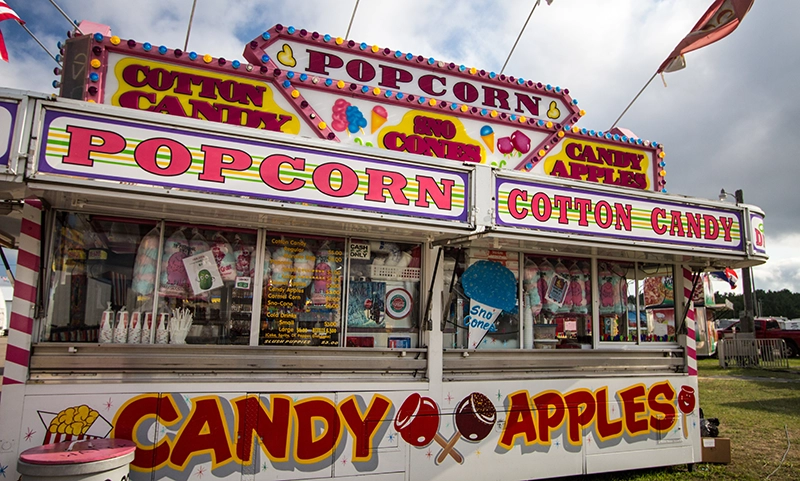
Can Small-Town Fairs Be Saved?
Maybe the better question is whether we still understand why it mattered in the first place.
There was a time when the county fair was one of the biggest events on the calendar.
You went because everyone went.
Farm families brought livestock. Gardeners brought tomatoes and jars of preserves. Someone entered a pie perfected over twenty years. Kids spent months preparing 4-H projects. Tractors were polished. Quilts were unfolded. Ribbons were awarded.
The midway lit up after dark.
Somebody you hadn’t seen since last year’s fair inevitably appeared in front of you.
And for a few days, an entire community gathered in the same place.
Today, many small-town and county fairs are struggling.
Attendance has changed. Volunteers are harder to find. Carnival companies have consolidated. Entertainment costs more. Agriculture itself has changed. Younger generations don’t necessarily have the same relationship with the fair that their grandparents did.
The easy conclusion is that the small-town fair belongs to another era.
I’m not convinced.
I think we’ve forgotten what made it important.
The Fair Was Never Really About the Ferris Wheel
We tend to remember the midway.
The lights. The rides. The games nobody could quite win. The smell of funnel cakes and livestock barns somehow occupying the same summer air.
But those weren’t necessarily what made the fair important.
The fair was important because it was one of the few places where an entire community crossed paths.
Farmers met merchants.
Children met grandparents.
Neighbors competed against neighbors.
Businesses supported civic organizations.
People demonstrated skills.
Families showed what they had grown, raised, baked, built, or created.
The fair wasn’t something produced for the community.
The community produced the fair.
That’s an important distinction.
And perhaps that’s where its future begins.
Don’t Recreate 1978
If small-town fairs are going to survive, trying to perfectly reproduce the fair of fifty years ago probably isn’t the answer.
The world around them has changed too much.
But the fundamental human needs the fair once served haven’t disappeared.
We still want to belong somewhere.
We still want to make things.
We still want recognition for doing something well.
We still enjoy a little friendly competition.
We still want our children to understand where food comes from.
We still want to hear stories about the places we call home.
And despite living in a world where nearly everything is available through a screen, we still crave opportunities to stand next to one another and experience something together.
Maybe the future fair begins there.
Make Us Participants Again
Somewhere along the way, much of American entertainment turned us into spectators.
We buy a ticket.
We sit down.
Someone entertains us.
Then we go home.
The old fair was different.
People participated.
Imagine restoring that idea on a much larger scale.
Best pie.
Best tomato.
Best salsa.
Best sourdough.
Best photograph of the county.
Best quilt.
Best woodworking project.
Best restored tractor.
Best garden.
Best flower arrangement.
Best barbecue.
Best farm dog.
And because a little ridiculousness is good for a community:
Best beard.
Best mullet.
Best decorated golf cart.
Competitions don’t have to be serious to accomplish something important.
They give people a reason to participate.
And participants bring people with them.
Suddenly Grandma isn’t attending the fair because someone convinced her to buy a ticket.
She’s attending because her granddaughter entered a photograph.
A family comes because Dad entered the barbecue competition.
Someone’s friends show up because she’s competing in the pie contest.
Participation creates investment.
Agriculture Still Belongs Here
Agriculture should remain at the heart of many rural fairs.
But agriculture shouldn’t be presented as though farming stopped evolving in 1965.
Keep the cattle.
Keep the hogs.
Keep the sheep, chickens, tractors,s and 4-H projects.
Then put modern agriculture beside them.
Precision agriculture.
Drones.
Soil health.
Beekeeping.
Hydroponics.
Regenerative agriculture.
Specialty crops.
Local orchards.
Farm wineries.
Food producers.
Young agricultural entrepreneurs.
Let a farmer explain why the tractor practically drives itself.
Let someone fly an agricultural drone.
Let a beekeeper open a hive.
Let children plant something.
Let people meet the men and women producing the food around them.
The fair could once again become the place where rural America explains itself.
Bring Back the Makers
This may be one of the greatest opportunities of all.
Imagine walking into a building where someone is forging steel.
Nearby, a woodworker is turning a bowl.
Outside, a portable sawmill is cutting a log into slabs.
Someone else is making pottery.
Another person is working leather.
An artist is painting.
Someone is restoring an antique piece of furniture.
A quilter is explaining a pattern passed down through generations.
None of them are simply selling something from behind a table.
They’re doing it.
They’re showing us how things are made.
We’ve entered a strange moment when millions of people watch blacksmiths, woodworkers, farmers, gardeners, and craftspeople on YouTube and social media.
Perhaps the fair can take those digital fascinations and make them tangible again.
Don’t show me a sign explaining blacksmithing.
Let me hear the hammer hit the anvil.
Made Here
What if the organizing idea behind a modern small-town fair became incredibly simple?
Made Here.
Food grown here.
Animals raised here.
Things built here.
Music played here.
Art created here.
Businesses started here.
Families rooted here.
Stories that happened here.
History preserved here.
People doing remarkable things here.
That gives a community something no amusement park, shopping center,r or streaming service can duplicate.
It gives the community itself.
The Fair Should Change After Sunset
And then evening comes.
The fair should change.
String lights come on.
Long communal tables fill.
Food vendors stay open.
Maybe there’s a local wine, beer, er or hospitality garden where appropriate.
A genuinely good regional Americana, bluegrass, blues, country, or roots band begins playing.
People stop moving.
They sit.
They talk.
Kids run around.
Neighbors reconnect.
Visitors become part of the place for a while.
The fair becomes something communities once had in abundance and increasingly struggle to maintain:
the town’s front porch.
Two Great Days Beat Four Mediocre Ones
Perhaps another tradition deserves reconsideration.
Does the fair really need to last four or five days?
For some communities, absolutely.
For others, maybe not.
Instead of stretching limited volunteers, entertainment,t and attendance across several days, imagine concentrating everything into an extraordinary Friday evening and Saturday.
Friday becomes the reunion.
Saturday becomes the fair.
A parade in the morning.
Livestock and youth competitions.
Makers and agricultural demonstrations.
Food competitions.
Children’s activities.
Local history.
Community competitions.
Music.
Dinner.
And then one signature Saturday-night event people anticipate all year.
A tractor pull.
A demolition derby.
A rodeo.
A barn dance.
A balloon glow.
A drone show.
Fireworks.
A concert.
Or perhaps something completely peculiar to that particular community.
In fact, peculiar might be better.
Because memorable communities aren’t generic.
Come Home
Another audience small-town fairs may be overlooking.
The people who left.
Nearly every rural community has them.
They graduated from the local high school and moved to Kansas City, St. Louis, Denver, Dallas, Chicago, or somewhere farther away.
But home is still home.
What if the annual fair became the unofficial homecoming weekend?
Schedule class reunions around it.
Invite former residents home.
Recognize century farms.
Celebrate longtime businesses.
Photograph multigenerational families.
Tell stories.
Host a community supper.
Create traditions specifically designed around coming home.
Then the invitation becomes something much more powerful than:
Come to the Fair.
It becomes:
Come Home.
Honor the Past Without Living in It. Something important goes far beyond fairs.
Small towns across America are wrestling with identity.
The hardware store disappears.
The local newspaper closes.
The school consolidates.
The café struggles.
Church attendance changes.
Family farms become fewer and larger.
Young people leave.
Old buildings disappear.
And gradually, the places where a community once encountered itself begin disappearing too.
That’s why saving a small-town fair isn’t really about saving carnival rides.
It’s about preserving one of the increasingly rare places where a community can tell its own story.
But preservation doesn’t mean freezing something in time.
We don’t need to pretend it’s 1955.
We need to take what mattered in 1955—community, participation, craftsmanship, agriculture, competition, storytelling, food, music, and belonging—and reinterpret it for 2026 and beyond.
Honor the past without pretending we still live in it.
Maybe We Need the Fair More Than We Realize
Travel has taught me something I didn’t fully understand when I was younger.
Places aren’t ultimately defined by monuments, buildings, or attractions.
They’re defined by people.
By stories.
By food.
By traditions.
By work.
By landscape.
By the things people make.
By the memories passed between generations.
And by the places where those things come together.
Sometimes we travel halfway around the world looking for authentic communities while overlooking the extraordinary stories quietly unfolding in our own towns.
Perhaps the small-town fair could become one of the places where we rediscover them.
Not as nostalgia.
Not as a museum.
Not as an attempt to recreate some supposedly perfect version of rural America that probably never existed anyway.
But as something alive.
Something evolving.
Something created by the people who live there.
A place where an eighty-year-old farmer and a sixteen-year-old drone pilot might both have something worth showing us.
Where a grandmother’s pie recipe can sit beside a young entrepreneur’s new food business.
Where a century-old farm can be celebrated alongside someone planting their first garden.
Where the blacksmith, beekeeper, artist, farmer, musician, woodworker, cook, and kid with the blue-ribbon chicken all become part of the same story.
Maybe the question isn’t:
Can we save the small-town fair?
Maybe the question is:
Can we reinvent the fair as a place where a community remembers who it is—and discovers who it is becoming?
I think we can.
And I think it might matter more than we realize.
Travel starts the moment you leave your comfort zone.
Sometimes that journey takes you across an ocean.
And sometimes it takes you right back to the county fair.
Robert Riesmeyer is the Founder and Travel Concierge/Host of Epic Explorations and the voice behind The Resonant Explorer. A lifelong traveler, storyteller, and relentlessly curious explorer, Robert looks beyond the obvious—into the people, history, culture, and unexpected stories that give a place meaning.
Based in the Kansas City area, he explores the world, follows intriguing rabbit holes, and seeks experiences most travelers overlook. For Robert, travel isn't about collecting destinations. It's about curiosity, connection, wonder, and discovering the stories that stay with us long after we return home.