
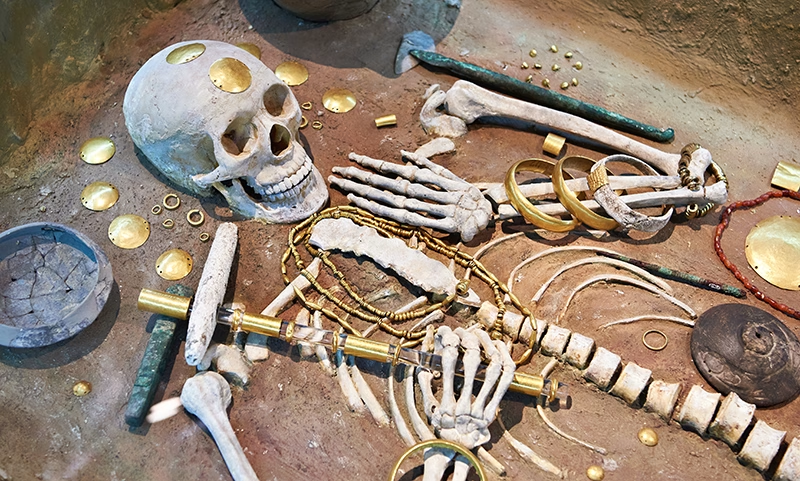
Photo Credit: Sergey Ryzhov - stock.adobe.com
Unearthing Gold and Gods: The Necropolis of Varna and the Dawn of Varna Culture
Discovering the Necropolis of Varna and the Varna Culture
There are moments in archaeology—rare, breathtaking moments—when an accidental find rewrites history. The Necropolis of Varna is one of those moments. Buried beneath the dusty terrain near Bulgaria’s Black Sea coast lies a cemetery that stunned the world with its silent testimony to a long-forgotten people: the Varna culture.
And here’s the twist—it holds the oldest gold treasure ever discovered.
Not in Egypt.
Not in Mesopotamia.
But in Bulgaria.
This article isn’t just about what was found—gleaming gold masks, ceremonial scepters, and exquisitely crafted jewelry—it’s about what it tells us: about social structure, spiritual belief, and the sophisticated world of a Neolithic culture most have never heard of.
Let’s peel back the layers of soil and centuries and step into the dawn of European civilization.
The Accidental Discovery That Shocked the World
In 1972, a humble construction project on the outskirts of modern-day Varna unearthed something remarkable. A worker digging a trench stumbled upon a grave filled with artifacts—bones, pottery, and gold that shimmered in the sunlight. Archaeologists were called in, and over the course of years, a total of 294 graves were excavated from the site now known as the Necropolis of Varna.
And in those graves? Over 6 kilograms of pure gold, dating back to 4,500 BCE.
Let that sink in. That’s 1,000 years before the pyramids of Egypt and 2,000 years before Troy was founded.
The burial goods revealed a people who valued artistry, symbolism, and hierarchy. But it’s what those items meant—and what they say about us—that makes this site truly worthy of your travel bucket list.
Who Were the People of the Varna Culture?
The Varna culture thrived in the Copper Age, a transitional period between the Stone Age and the Bronze Age. Occupying what is today northeastern Bulgaria, they were skilled farmers, traders, and metallurgists.
Their reach, however, extended far beyond the boundaries of their modest geography. Artifacts found in the Necropolis of Varna indicate trade connections with the Aegean, the Danube Basin, and possibly as far as the Near East.
And that gold? It wasn’t just decoration. It was a declaration.
Gold diadems, breastplates, bracelets, and scepters—crafted with stunning precision—were buried with specific individuals. Some bodies were adorned head to toe, while others had symbolic offerings. This indicates a society with distinct social stratification—a hierarchy that suggests organized religion, leadership roles, and possibly early royalty.
This was not a primitive tribe. This was a complex, socially aware, and spiritually attuned civilization.
Grave 43 – The King Without a Name
Of all the graves uncovered, one continues to captivate historians and visitors alike: Grave 43.
It belonged to a male—estimated to be around 40–50 years old—buried with more than 1.5 kilograms of gold. His burial was symbolic, not just wealthy. The placement of the items—crowns, chest pieces, and phallic ornaments—spoke volumes. This wasn’t just a leader. This was a figure of sacred authority, a king-priest, a proto-monarch of prehistory.
His was not the only grave to receive such honor, but it was the richest. And curiously, there were no signs of a warrior’s life. No trauma, no tools of battle. His power came from something else—perhaps trade, perhaps ritual, perhaps divinely sanctioned rule.
This grave alone would’ve made headlines. But multiply that level of significance across nearly 300 burials, and you begin to glimpse a world we’re only starting to understand.
Gold, God, and the Afterlife
The people of the Varna culture didn’t just hoard gold—they gave it to the dead.
Why?
Because they believed in something beyond. The sheer quantity and arrangement of items in the Necropolis suggest a detailed cosmology. Items weren’t randomly tossed into graves; they were ritually placed. Some graves even contained cenotaphs—tombs with no bodies, only offerings—indicating beliefs in ancestral worship, fertility rites, or divine representation.
They may have believed in reincarnation or a journey to an afterlife, judging by the presence of symbolic boats, tools, and ritual weapons.
What we find here is a spiritual sophistication long before the codified religions of Greece, Rome, or even Mesopotamia. In fact, the Varna culture’s burial practices predate and likely influenced later Balkan and Mediterranean traditions.
What Makes This Site So Important?
The Necropolis of Varna and the Varna culture together reshape what we thought we knew about the origins of European civilization. Here’s why it matters:
-
It challenges the East-centric timeline of ancient innovation.
-
It presents evidence of a structured society with trade, wealth, and religion.
-
It showcases metallurgy far more advanced than previously believed.
-
It proves that art, symbolism, and hierarchy existed in Neolithic Europe.
And from a travel perspective? It’s one of the most underrated destinations in world archaeology.
Planning a Visit to the Necropolis of Varna
If you’re like me, you’re already mentally packing your carry-on.
While the original site is not open to the public in full, you can visit the Varna Archaeological Museum, which houses the treasures of the Necropolis. The displays are world-class—think glistening gold masks, tools of worship, pottery painted with spirals and suns, and interpretive reconstructions of the burial rituals.
Varna itself is a seaside stunner. Located along Bulgaria’s Black Sea coast, it offers a refreshing mix of sun, sand, and serious culture. You can swim in the sea in the morning, sip rakia by noon, and stand in front of the world’s oldest crafted gold by afternoon.
Other Sites to Explore While in Bulgaria
Make a full journey of it. Bulgaria is brimming with mysterious archaeological finds and untouched wonders.
-
The Madara Rider: An ancient rock relief of a horseman carved high into a cliff face.
-
Thracian Tomb of Kazanlak: A UNESCO World Heritage site, rich with wall paintings and tomb art.
-
Plovdiv’s Roman Amphitheatre: One of the best-preserved in the Balkans.
-
Perperikon: A massive ancient megalithic sanctuary in the Rhodope Mountains.
Each stop offers echoes of forgotten cultures, whispering legends to those curious enough to listen.
Final Thoughts: Why the Necropolis of Varna Still Matters
When you walk into that museum and stand before those golden relics, you’re not just observing the past—you’re standing in the presence of the beginning of something immense.
The Necropolis of Varna and the Varna culture remind us that humanity has always reached for the divine, created beauty from earth, and honored its dead with reverence. Before pharaohs, before kings, before temples carved in stone—there was Varna.
And for those of us chasing the world’s deepest wonders, this is where the journey must lead.
So go. See the gold that outdates history. Feel the stillness of a civilization resurrected. And remember, long before the known world knew itself—Varna was already dreaming.
Call to Action:
Curious to curate a journey through Bulgaria’s ancient past? Let Epic Explorations design an immersive experience through Varna and beyond. Contact us to start planning your archaeological adventure.
More Articles:
Chavin de Huantar
Giants Grave - Sardinia

Explore Your World Epically
Robert Riesmeyer is the Founder and Travel Concierge/Host of Epic Explorations and the voice behind The Resonant Explorer. A lifelong traveler, storyteller, and relentlessly curious explorer, Robert looks beyond the obvious—into the people, history, culture, and unexpected stories that give a place meaning.
Based in the Kansas City area, he explores the world, follows intriguing rabbit holes, and seeks experiences most travelers overlook. For Robert, travel isn't about collecting destinations. It's about curiosity, connection, wonder, and discovering the stories that stay with us long after we return home.