
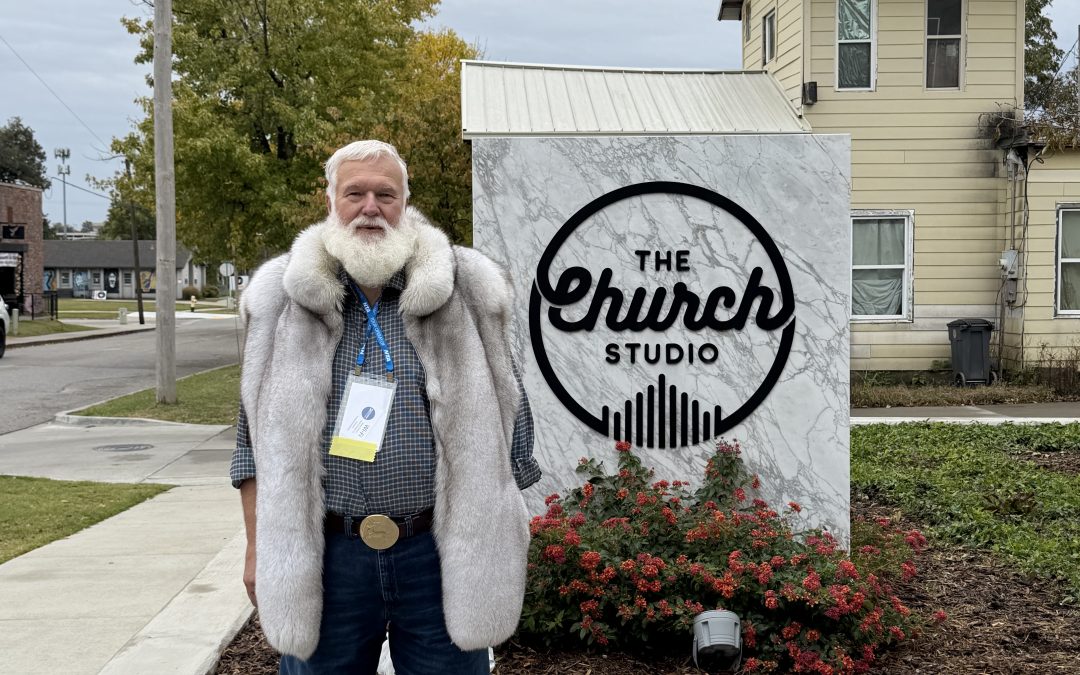
Leon Russell, a forgotten church, and the unexpected connections that keep music alive.
Some places have a peculiar way of reaching into the forgotten corners of our memories.
You walk through a doorway expecting to discover something new, only to find yourself remembering something you hadn't thought about in years.
A conversation with your father. A concert nearly half a century ago. A name you haven't heard in decades.
And suddenly, the distance between then and now doesn't seem quite so great.
That happened to me in Tulsa, Oklahoma.
It began with an old church.
Not just any church, but one that Leon Russell purchased in 1972 and transformed into a recording studio. A place where musicians gathered, experimented, challenged one another, and helped create a sound that would travel far beyond Oklahoma.
Today, we know it as The Church Studio.
But somewhere between the stories of famous musicians and the remarkable history of the building, my thoughts wandered back to a little town in Missouri.
And to my father.
A Night in Wellington
My father, Bob Riesmeyer, was a director of the Wellington Fair, an annual September tradition in our hometown of Wellington, Missouri.
Among his responsibilities was helping arrange the entertainment.
Years later, Dad told me about a particularly unusual booking.
One of the agents they worked with also represented Bob Wills, the legendary Western swing bandleader. As Dad remembered it, Wills had played somewhere around Independence, Missouri, and had an open night before his next engagement.
A telephone call was made. Arrangements came together.
And somehow, Bob Wills ended up performing at the city park and fairgrounds in Wellington.
I don't know what year it happened. I don't know how many people attended or what songs he played.
Dad told me the story late in his life, and the people who might have remembered the evening are gone now.
There may be no surviving program, newspaper clipping, or photograph.
But I remember Dad telling me.
And the older I get, the more I appreciate the stories we carry simply because someone took the time to share them.
The Music Finds Another Generation
In 1979, I attended my first concert as a student at the University of Missouri.
The band was Asleep at the Wheel.
Led by Ray Benson, the group had embraced Western swing, carrying forward the musical tradition that Bob Wills and his Texas Playboys had helped popularize decades earlier.
I wasn't thinking about musical genealogy that evening.
I was a college student enjoying a concert.
But music has a way of connecting experiences long before we recognize the connections.
Nearly half a century later, I found myself at Cain's Ballroom in Tulsa, the legendary venue where Bob Wills and his Texas Playboys had helped establish Western swing as a defining sound of the American Southwest.
There was live music that evening. People were two-stepping across the floor.
And somewhere in the back of my mind, those old memories began stirring.
Dad's story about Wellington.
Asleep at the Wheel at Mizzou.
The music hadn't stopped. It had simply traveled through different places, different people, and different generations.
And that brings me back to Leon Russell.
The Man Who Bought a Church
By the early 1970s, Leon Russell had already established himself as one of the most versatile musicians in American popular music.
He had worked in Los Angeles recording studios, collaborated with major artists, helped organize Joe Cocker's Mad Dogs & Englishmen tour, and participated in George Harrison's Concert for Bangladesh.
He knew the music business from nearly every angle.
Yet in 1972, Russell returned to Tulsa and purchased a former church.
Together with producer Denny Cordell, his partner in Shelter Records, he helped transform the building into a place where musicians could create outside some of the conventions of the established recording industry.
There were recording studios in Los Angeles, Nashville, and New York.
Why Tulsa?
Perhaps part of the answer lies in the musical community that already existed there.
Tulsa had long been a crossroads of musical traditions. Country and Western swing mingled with blues, gospel, rhythm and blues, and rock and roll.
Musicians borrowed from one another, sometimes without worrying very much about which musical category their work belonged in.
Russell understood that environment.
And rather than simply taking Tulsa's musicians elsewhere, he helped create a place where their creativity could flourish at home.
The Sound That Didn't Need a Label
The Tulsa Sound is difficult to define precisely.
Listen to J.J. Cale and you hear an understated, almost effortless approach to blues and rock. His guitar playing leaves room for silence. His vocals rarely seem interested in competing with the instruments.
Listen to Leon Russell and you encounter something different: gospel-infused piano, powerful arrangements, and a voice that seems to carry a lifetime of musical influences.
Freddie King's blues brought another dimension to the musical community associated with Shelter Records.
These musicians didn't sound alike.
And perhaps that's what made their connections so interesting.
They weren't trying to reproduce a formula.
They were bringing their individual experiences into a shared creative environment.
The Church Studio became one of the places where that exchange could happen.
Not every famous artist associated with Leon Russell or Shelter Records actually recorded inside its walls. The label operated in multiple locations, and Russell's musical relationships stretched across the country.
But the studio's importance wasn't dependent upon collecting the largest possible list of celebrity names.
Its importance was rooted in the opportunities it created for musicians to work together.
Sometimes the most influential person in a room isn't the one making the most noise.
Sometimes it's the person who makes room for everyone else to be heard.
When the Music Grew Quiet
Eventually, Russell moved on, and The Church Studio passed through other hands.
The building continued to have a musical life, but time was not particularly kind to it.
By the time Tulsa entrepreneur Teresa Knox acquired the property in 2016, the former church needed extensive restoration.
She undertook an ambitious effort to preserve its history and return it to an active role in the city's musical community.
The restored Church Studio reopened in 2022.
There are photographs, artifacts, recording equipment, and exhibits celebrating Leon Russell and the artists associated with the studio.
But what interests me most isn't what has been placed on display.
It's what hasn't stopped happening.
Music.
The Church Studio is once again a working recording facility. Musicians continue to gather within its walls. New recordings are being made. New stories are unfolding.
And the studio hosts intimate performances that bring musicians and audiences together in a setting far removed from the enormous arenas and concert halls that dominate much of today's live music industry.
During my visit, I learned about concerts with audiences limited to approximately one hundred people.
Imagine that.
Not a sea of thousands of strangers watching distant figures on a stage, but a small gathering sharing the experience of music in a room filled with musical history.
Perhaps even hearing the story behind a song from the person who wrote it.
That is the kind of experience that stays with you.
The Things We Carry
I've been thinking about what connects these seemingly unrelated experiences.
A booking agent who knew someone at the Wellington Fair.
A father who told his son about an unexpected performance by Bob Wills.
A college student listening to Asleep at the Wheel in 1979.
Leon Russell creating a gathering place for musicians in Tulsa.
Teresa Knox recognizing that an aging building still had something to offer future generations.
At first glance, they're separate stories.
But each involves someone creating an opportunity for others to experience something meaningful.
And each reminds us that music is about more than the notes being played.
It's about the people who bring those notes into our lives.
I don't know whether my father ever imagined that his story about Bob Wills would come back to me while exploring Tulsa's musical heritage.
I certainly didn't anticipate it.
Yet there I was, decades later, finding connections between places and people separated by years and miles.
Perhaps that's one of the remarkable things about travel.
We set out hoping to discover something about the world.
And occasionally, somewhere along the way, we rediscover something about ourselves.
The Music Between the Notes
There's a temptation when visiting historic places to focus on the famous names, the important dates, and the objects preserved behind glass.
Those things matter.
But they aren't the whole story.
The Church Studio reminds us that creativity flourishes through relationships. That music travels through communities and generations. That a place can matter not simply because of what happened there, but because of what it continues to make possible.
Leon Russell helped create that possibility more than fifty years ago.
Teresa Knox and the people who have worked to restore The Church Studio have given it another life.
And somewhere inside that old church in Tulsa, musicians may be creating something today that will find its way into someone else's memories decades from now.
Maybe a song heard on the radio.
Maybe a concert attended with friends.
Maybe a story a father will someday tell his son.
We never really know where the music will take us.
Or when it might bring us home.
The Resonant Explorer is where we follow the stories, people, places, and unexpected discoveries that make travel so much more than simply visiting another destination. Some stories are planned. Others find us. And those are often the ones that stay with us the longest.
Robert Riesmeyer is the Founder and Travel Concierge/Host of Epic Explorations and the voice behind The Resonant Explorer. A lifelong traveler, storyteller, and relentlessly curious explorer, Robert looks beyond the obvious—into the people, history, culture, and unexpected stories that give a place meaning.
Based in the Kansas City area, he explores the world, follows intriguing rabbit holes, and seeks experiences most travelers overlook. For Robert, travel isn't about collecting destinations. It's about curiosity, connection, wonder, and discovering the stories that stay with us long after we return home.