
Beyond the Noble Grapes: What Does America Taste Like?
Your content goes here. Edit or remove this text inline or in the module Content settings. You can also style every aspect of this content in the module Design settings and even apply custom CSS to this text in the module Advanced settings.
Every once in a while, I stumble across something that sends me down a rabbit hole.
This one started with American native grape wines.
More specifically, it started with a winery practically in our own backyard doing something I didn't realize anyone was doing: exploring what American wine might taste like if we stopped trying so hard to make it taste like somewhere else.
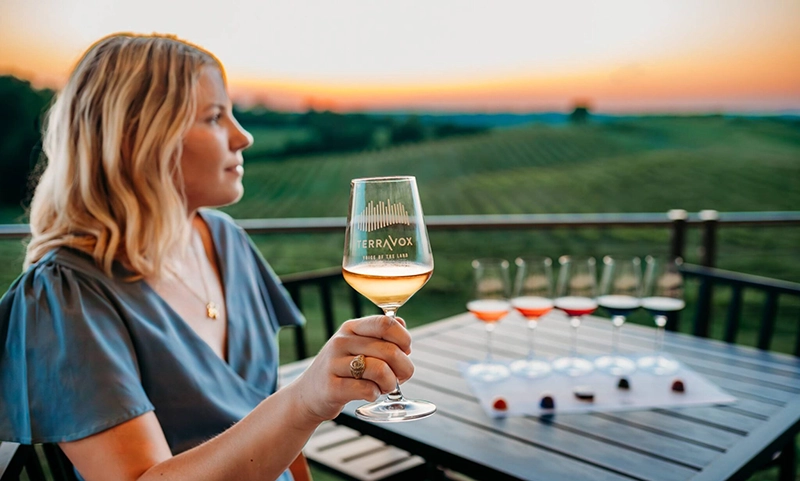
That place is TerraVox Winery, located among the rolling hills north of Kansas City, Missouri.
TerraVox is experimenting with dozens of native, hybrid and historically significant American grape varieties, many carrying names most wine drinkers have probably never encountered. Its work with American native grape wines raises a wonderfully simple question:
What does America taste like when we allow it to taste like itself?
The more I learned about TerraVox, the more the question changed.
This wasn't really a story about wine.
It was a story about place.
Who Decided Which Grapes Were Noble?
Spend enough time around wine and eventually you'll encounter the term “noble grapes.”
Traditionally, six varieties are commonly included: Cabernet Sauvignon, Merlot, Pinot Noir, Chardonnay, Sauvignon Blanc and Riesling.
They're extraordinary grapes. They've produced some of the world's greatest wines, and their ability to express different soils and climates is part of the reason they've been planted around the world.
But here's where the rabbit hole opened.
“Noble grape” isn't an official classification.
There isn't some international council sitting in a stone cellar in France that bestowed nobility upon six grapes and condemned everything else to the peasantry.
It's a convention.
And conventions have histories.
Which made me wonder:
What happened to all the other grapes?
More specifically:
What happened to ours?
American Native Grape Wines Have a Story of Their Own
North America has its own extraordinary viticultural history.
Wild grapes were growing on this continent long before Europeans arrived. Over generations, growers, horticulturists and breeders experimented with native species and crosses, attempting to discover grapes capable of producing distinctive American native grape wines while thriving in American soils and climates.
One of the most fascinating characters in that history was Thomas Volney Munson, better known as T.V. Munson.
Working during the late 19th and early 20th centuries, Munson became one of America's foremost authorities on native grape species. He collected them, classified them, experimented with them and developed new varieties.
His work also became connected to one of the great crises in wine history.
During the 19th century, phylloxera devastated European vineyards. The tiny insect attacked the roots of European grapevines with catastrophic consequences.
Part of the solution came from America.
European grape varieties could be grafted onto resistant American rootstock, allowing vineyards to survive. Munson's knowledge of American grape species contributed to identifying appropriate rootstocks for European vineyards.
There is something wonderfully ironic about that.
American grapevines helped preserve European wine culture.
Yet somewhere along the way, Americans became increasingly convinced that serious American wine should be made primarily from European grapes.
Our native grapes largely disappeared from the broader conversation about fine wine.
That's where TerraVox enters our story.
A Missouri Farm Boy Finds an Old Book
TerraVox founder Jerry Eisterhold grew up around wild grapes in Missouri's Gasconade River Valley, upstream from Hermann.
Then, in 1978, while living in Midtown Kansas City, he discovered Munson's Foundations of American Grape Culture.
Apparently Jerry did what any properly curious person does when encountering an almost-forgotten chapter of history.
He started pulling on the thread.
And kept pulling.
He requested grape cuttings connected to Munson's work and planted them in his Kansas City backyard.
That didn't go particularly well.
Too much shade.
Too many squirrels.
He tried again in Overland Park.
Still shade. Still squirrels. Now sparrows joined the conspiracy.
Then came Peculiar, Missouri, where the growing conditions improved considerably.
Unfortunately, horses got into the vineyard.
They ate the grapevines.
Most people would probably have taken the hint.
Jerry Eisterhold was not most people.
Eventually, he and his wife Kate reportedly rented an airplane and flew over the Kansas City region looking for land with the combination of topography and soil he wanted.
By the mid-1990s, Jerry was establishing experimental vineyard rows north of Kansas City, ultimately working with more than 60 varieties.
He later traveled to California for extension courses at UC Davis covering winemaking, chemistry, pest management, irrigation and sensory analysis.
Think about that for a moment.
This began with an old book.
It became decades of experimentation with grapes most of us have never tasted—or even heard of.
That is the kind of obsession I find fascinating.
And it makes TerraVox an extraordinary place to begin understanding American native grape wines.
A Vineyard Full of Names You've Probably Never Heard
Today TerraVox works with grapes bearing names that sound almost like characters from a forgotten American novel:
Wetumka.
Cloeta.
Hidalgo.
Albania.
America.
Herbemont.
Lenoir.
Marguerite.
Volney.
Wine King.
And, more familiarly to Missouri wine drinkers, Norton.
TerraVox says every grape used in its wines is grown on its own property. No fruit or juice is purchased from somewhere else and brought in to make the wine.
That matters.
Because this experiment with American native grape wines isn't simply about producing unusual wine.
It's about discovering what these grapes can express from this particular piece of Missouri.
Consider Wetumka.
Developed by T.V. Munson in the 1890s, Wetumka can produce a wine TerraVox describes as carrying aromas of green pineapple and lemon verbena, with substantial natural acidity.
When was the last time someone asked you whether you'd prefer Chardonnay, Sauvignon Blanc...
or Wetumka?
Exactly.
That's what makes this so much fun.
Maybe We've Been Asking the Wrong Question
American wine conversations often begin with comparisons.
Is this Cabernet as good as one from Napa?
Does this Pinot resemble Burgundy?
Can this sparkling wine compete with Champagne?
Those are legitimate questions.
But they're not the only questions.
Maybe there's another one:
What can we taste here that we cannot taste anywhere else?
That's where American native grape wines become particularly interesting.
Because wine becomes something more than a beverage.
It becomes geography.
Agriculture.
History.
Climate.
Culture.
People.
Story.
It becomes terroir.
And if we're genuinely interested in terroir, shouldn't we occasionally stop asking whether a place can successfully imitate another place?
Perhaps the more interesting question is whether it can reveal something entirely its own.
What Does America Taste Like?
That's the question I can't shake.
We talk frequently at Epic Explorations about experiencing the world through stories and the people who carry them.
We also talk about American terroir—the idea that landscapes, agriculture, food, craft and traditions can help us understand a place.
Exploring American native grape wines may be one of the most interesting ways to experience that idea.
Wine is an agricultural product.
A grape grows somewhere.
Its roots enter a particular soil.
It experiences a particular amount of rainfall, heat, cold, wind and sunlight.
Someone tends it.
Someone decides when to harvest it.
Someone decides what to do with the juice.
Eventually someone pours it into a glass.
And then someone else tastes that place.
But what if the grape itself also carries a story?
What if it nearly disappeared?
What if someone spent decades trying to understand it?
What if its ancestors grew on this continent while America's wine identity was still being imagined?
Now the glass contains something else.
Memory.
And suddenly tasting an unfamiliar wine isn't simply about deciding whether we like it.
It's about discovering something.
Maybe American Wine Doesn't Need to Taste Like Europe
To be clear, none of this is an argument against European grapes.
I happen to enjoy many of them.
There is a reason Cabernet Sauvignon, Pinot Noir, Chardonnay, Riesling and the others became some of the most celebrated wine grapes in the world.
But appreciating those wines doesn't prevent us from being curious about something else.
Perhaps there is room at the table for both.
We can appreciate Burgundy while wondering what Norton tells us about Missouri.
We can enjoy Riesling while becoming curious about Wetumka.
We can drink Chardonnay while asking why someone has spent decades preserving grapes called Cloeta, Hidalgo, America and Albania.
That's the part of American native grape wines that intrigues me most.
They aren't asking us to abandon something familiar.
They're inviting us to taste something we've forgotten.
So We're Going to TerraVox
This rabbit hole has officially moved beyond my computer screen.
Linda and I are going to make a day of it.
We'll head toward Weston and visit TerraVox.
But I don't particularly want to arrive with the objective of deciding whether these wines are “better” than Cabernet, Chardonnay or Pinot Noir.
That misses the point.
I want to taste something unfamiliar.
I want to stand in the vineyard.
I want to understand why someone would devote decades to grapes most Americans have never heard of.
I want to hear the stories behind Wetumka, Cloeta, Albania, America and whatever else ends up in our glasses.
And I want to begin understanding American native grape wines through the people actually growing the grapes and making the wine.
Most of all, I want to explore the question that started this entire rabbit hole:
What does America taste like when we allow it to taste like itself?
I don't know the answer yet.
That's why we're going.
And that's really the whole point of being a Resonant Explorer.
Sometimes you find the story.
Sometimes the story gives you a reason to get in the car and go looking for the rest of it.
And every once in a while, a bottle of American native grape wine may be enough to start the journey.
Your content goes here. Edit or remove this text inline or in the module Content settings. You can also style every aspect of this content in the module Design settings and even apply custom CSS to this text in the module Advanced settings.

Robert Riesmeyer is the Founder and Travel Concierge/Host of Epic Explorations and the voice behind The Resonant Explorer. A lifelong traveler, storyteller, and relentlessly curious explorer, Robert looks beyond the obvious—into the people, history, culture, and unexpected stories that give a place meaning.
Based in the Kansas City area, he explores the world, follows intriguing rabbit holes, and seeks experiences most travelers overlook. For Robert, travel isn't about collecting destinations. It's about curiosity, connection, wonder, and discovering the stories that stay with us long after we return home.